
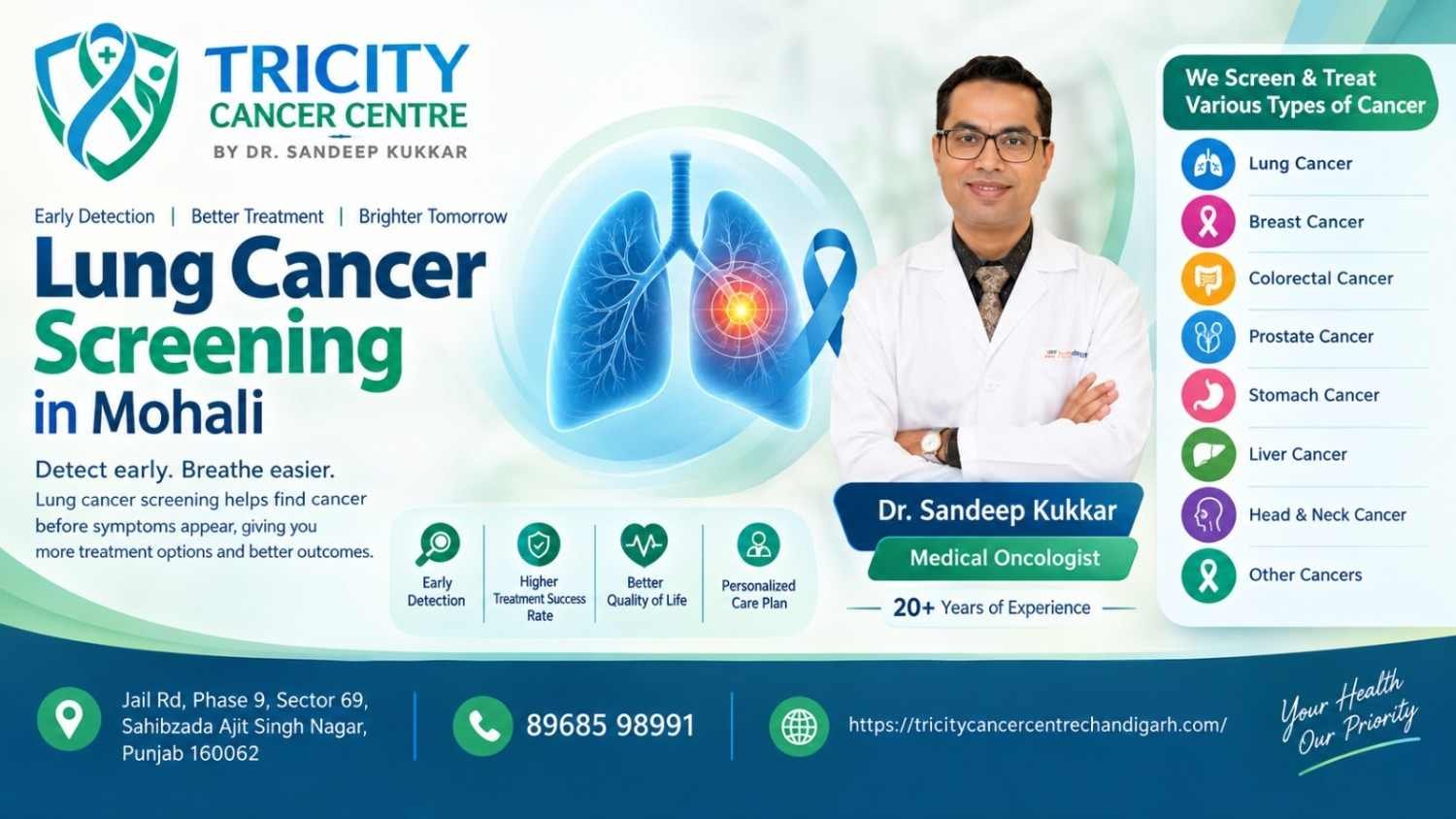
Lung cancer is often diagnosed at an advanced stage simply because it produces no symptoms in its earliest, most treatable form. This is exactly why Lung Cancer Screening in Mohali has become such an important part of modern cancer care — catching the disease before symptoms even appear, when treatment options are far more effective. At Tricity Cancer Centre, Dr. Sandeep Kukkar guides high-risk patients through structured screening protocols designed to detect lung cancer at its earliest, most curable stage.
Why Lung Cancer Screening in Mohali Matters
Unlike many cancers that produce early warning signs, lung cancer frequently grows silently for months, sometimes years, before a persistent cough, chest pain, or breathlessness prompts a doctor’s visit. By the time symptoms appear, the cancer has often progressed to a later stage, where treatment becomes more complex and outcomes less favorable.
Screening changes this equation entirely. Rather than waiting for symptoms, Lung Cancer Screening in Mohali allows high-risk individuals to be checked proactively — often catching small, localized tumors that are far easier to treat successfully than advanced-stage disease.
The Core Purpose of Screening
Screening is not the same as diagnosis. It’s a proactive tool used on people who show no symptoms but carry risk factors that make them more likely to develop lung cancer. The goal is simple: find cancer early, when a cure is realistically possible.
What Is a Low-Dose CT Scan?
The primary tool used for lung cancer screening today is the Low-Dose CT (LDCT) scan — a specialized imaging test that has largely replaced older screening methods like chest X-rays, which frequently miss small, early-stage tumors.
How It Works
A Low-Dose CT scan uses significantly less radiation than a standard CT scan while still producing detailed cross-sectional images of the lungs. The scan takes only a few minutes, requires no injections or special preparation, and allows radiologists to detect nodules as small as a few millimeters — well before they would show up on a regular chest X-ray or become large enough to cause symptoms.
Why Low-Dose Specifically?
Because screening is typically repeated annually for high-risk individuals over several years, minimizing radiation exposure with each scan is essential. The “low-dose” protocol strikes the right balance — detailed enough to catch small nodules, safe enough for repeated annual use.
What Happens During the Scan
Patients lie on a scanning table while the CT machine takes rapid images of the chest. There’s no need to hold your breath for long periods, no contrast dye is typically required, and the entire procedure is completed within 10–15 minutes, including preparation time.
Who Should Consider Lung Cancer Screening in Mohali?
Screening isn’t recommended for everyone — it’s specifically targeted at individuals with a meaningfully elevated risk of developing lung cancer.
High-Risk Categories
- Current or former heavy smokers — typically defined as a significant pack-year smoking history
- Age 50 to 80 — the age range where lung cancer risk rises substantially
- Former smokers who quit within the past 15 years — risk remains elevated even after quitting
- Individuals with occupational exposure to asbestos, radon, or other lung carcinogens
- A family history of lung cancer, particularly in a first-degree relative
A Quick Note on Non-Smokers
While smoking remains the leading risk factor, lung cancer can also occur in non-smokers due to air pollution exposure, radon gas, genetic factors, or prior lung disease. Dr. Sandeep Kukkar evaluates each patient’s individual risk profile at Tricity Cancer Centre, rather than relying on smoking history alone.
Benefits of Early Detection Through Screening
Catching lung cancer through screening, before symptoms develop, offers several significant advantages:
- Higher likelihood of detecting cancer at Stage 1, when it’s most treatable
- Greater range of treatment options, including surgery, which is often most effective on early-stage tumors
- Improved long-term survival rates compared to symptom-triggered diagnosis
- Reduced need for aggressive, complex treatment protocols
- Peace of mind for high-risk individuals through regular monitoring
What Happens After Screening?
If the Scan Is Normal
Patients typically continue annual screening as recommended, since lung cancer risk persists over time for those in high-risk categories.
If a Nodule Is Found
Not every nodule detected on a Low-Dose CT scan is cancerous — in fact, most aren’t. At Tricity Cancer Centre, Dr. Sandeep Kukkar reviews the size, shape, and characteristics of any detected nodule to determine the appropriate next step, which may include:
- Short-interval follow-up scans to monitor for growth
- Additional imaging, such as a PET-CT scan, for further evaluation
- A biopsy, if the nodule shows features suspicious for malignancy
This structured, cautious approach avoids unnecessary alarm while ensuring nothing concerning goes unaddressed. If a diagnosis is confirmed, patients can seamlessly transition to comprehensive Lung Cancer Treatment in Mohali at Tricity Cancer Centre — including chemotherapy, immunotherapy, and targeted therapy — without needing to switch providers or start over with a new specialist.
Why Choose Dr. Sandeep Kukkar for Lung Cancer Screening in Mohali
With over 20 years of experience in medical oncology, Dr. Sandeep Kukkar brings the same thorough, individualized approach to both screening and Lung Cancer Treatment in Mohali — evaluating each patient’s personal and family risk factors rather than applying a one-size-fits-all protocol.
At Tricity Cancer Centre, patients undergoing lung cancer screening benefit from:
- Personalized risk assessment before recommending screening
- Access to modern diagnostic imaging technology
- Clear guidance on findings, without unnecessary alarm over incidental results
- A direct pathway to further evaluation or treatment planning, all under one roof, if needed
Final Thoughts
Lung Cancer Screening in Mohali gives high-risk patients a genuine chance to catch the disease before it turns life-threatening. This includes long-term smokers, those with significant occupational exposure, and people with a family history of lung cancer. For anyone in these groups, a simple conversation with an experienced oncologist about screening can make a big difference.
Whether you need screening to catch the disease early, or comprehensive Lung Cancer Treatment in Mohali if a diagnosis is confirmed, Dr. Sandeep Kukkar and the team at Tricity Cancer Centre are equipped to support you through every stage.
If you believe you may be at higher risk for lung cancer, consult Dr. Sandeep Kukkar at Tricity Cancer Centre to discuss whether a Low-Dose CT screening is right for you.
Book your screening consultation today.
Frequently Asked Questions
1. Who should get screened for lung cancer in Mohali?
Individuals aged 50–80 with a significant smoking history, former smokers who quit within the last 15 years, and those with occupational exposure to lung carcinogens or a family history of lung cancer should discuss screening with an oncologist.
2. Is a Low-Dose CT scan safe?
Yes. It uses significantly less radiation than a standard CT scan and is considered safe for annual repeated use in high-risk individuals, under medical guidance.
3. Does finding a nodule on a screening scan mean I have cancer?
No. Most nodules detected during screening are benign. Dr. Sandeep Kukkar evaluates each finding carefully and recommends follow-up imaging or further testing only when necessary.
4. How is lung cancer screening different from a diagnostic scan?
Screening is done on people without symptoms to catch potential cancer early, while diagnostic scans are used to investigate existing symptoms or confirm a suspected diagnosis.
5. How often should high-risk individuals be screened?
Annual screening is generally recommended for those who remain in a high-risk category, with the exact schedule personalized based on individual risk factors.
